Welsh Village Gets First Mobile Coverage After EE Installs Lamp Post Mast
 Julian Glover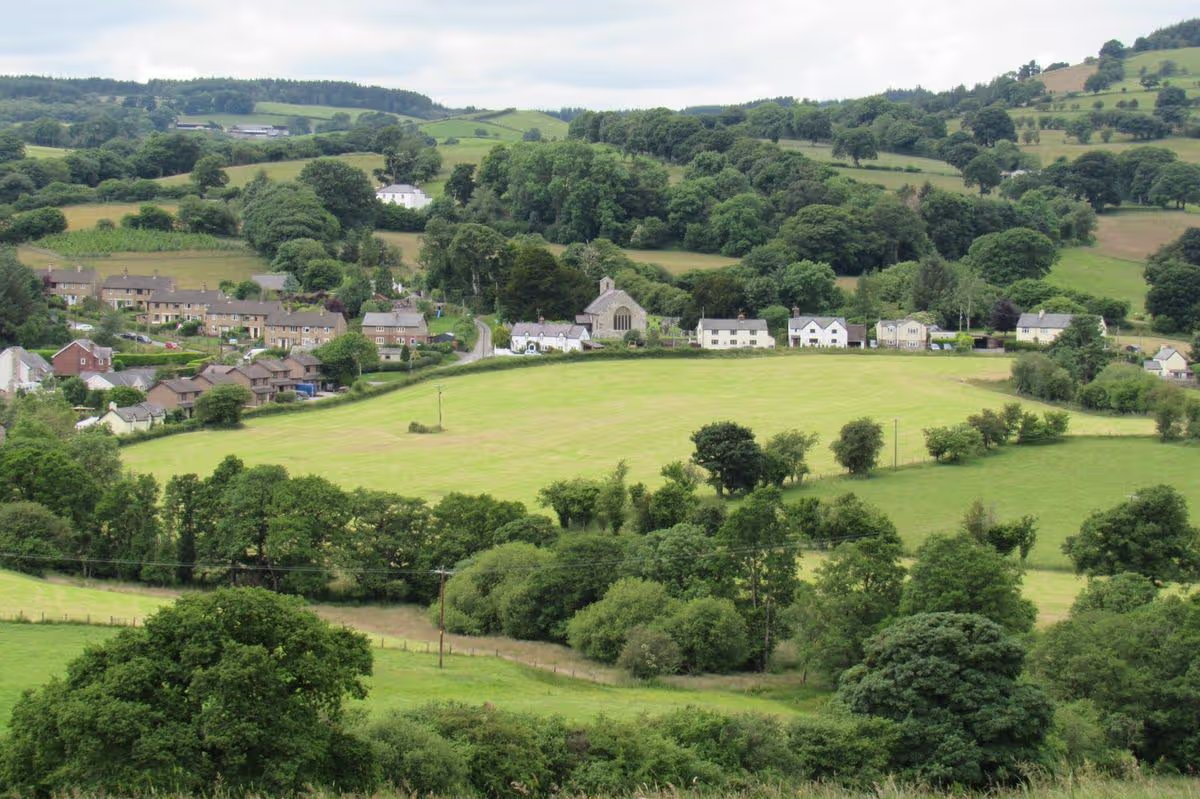
A Denbighshire village has finally joined the mobile age after spending decades without any cellular coverage.
Clocaenog, a rural community in North Wales, now has 4G access following the installation of a compact mobile mast by EE on an existing lamp post. The deployment eliminates what residents describe as a frustrating connectivity gap in a village that has had full fibre broadband for years.
"We've had brilliant internet at home for quite a while, but the moment you stepped outside, your phone became useless," said Margaret Davies, who runs a bed and breakfast on the village's main road. "Guests would arrive and immediately lose signal. It was embarrassing trying to explain that yes, we have superfast broadband, but no, you can't use your mobile."
Bridging the Digital Divide
The lamp post installation represents a growing trend in rural connectivity solutions. Traditional mobile masts require significant infrastructure investment and planning permission, often making them uneconomical for small communities.
EE's compact equipment attaches directly to existing street furniture, drastically reducing installation costs and deployment time. The approach has proven particularly effective in villages like Clocaenog, where the population doesn't justify a full-sized mast but residents still need reliable mobile access.
"This isn't about downloading movies on your phone," explained local councillor Robert Hughes. "It's about being able to call for help in an emergency, about businesses being able to take card payments, about farmers checking livestock prices while they're out in the fields."
The village sits in an area with patchy mobile coverage despite Openreach having deployed full fibre-to-the-premises infrastructure throughout the community. That created an unusual situation where homes had some of the fastest fixed broadband speeds in Wales but residents couldn't make basic phone calls without driving several miles.
Economic Impact for Local Businesses
Local shop owner Elin Thomas said the lack of mobile coverage had directly affected her takings. "At least three or four times a week, someone would come in wanting to buy something and their contactless wouldn't work because there's no signal," she said. "They'd have to drive to the cashpoint in the next village. Most just didn't bother coming back."
The tourism sector faced similar challenges. Clocaenog sits near popular walking routes and cycling trails, but visitors frequently complained about being unable to access maps, contact accommodation providers, or share photos of the scenic countryside.
"We'd see walkers coming through looking completely lost," Davies added. "Their phone GPS would work fine until they got here, then nothing. Some turned back rather than risk getting properly lost without being able to call for help."
Technical Solution
The mini mast connects to EE's network infrastructure through the existing fibre broadband lines, eliminating the need for separate backhaul connections. The equipment draws power from the lamp post's electrical supply and requires minimal maintenance.
EE has deployed similar installations across rural Britain as part of the government's Shared Rural Network programme. The initiative aims to eliminate mobile not-spots by 2025, with operators sharing infrastructure costs and coverage obligations.
The Clocaenog installation took less than a week from start to finish, compared to the months or years typically required for traditional mast planning and construction.
Resident Response
Farm manager David Williams said the change would transform his daily operations. "I've got fields spread across three miles. Before this, I'd have to drive back to the farmhouse every time I needed to check something or make a call," he said. "Now I can coordinate with contractors, check weather forecasts, and keep in touch with the family without wasting an hour driving back and forth."
The coverage extends roughly 500 metres from the lamp post, enough to cover the village centre and immediate surroundings. Some outlying properties still lack signal, but residents say the improvement marks a significant step forward.
Hughes acknowledged that full coverage would require additional installations. "We're in conversations with other operators about expanding coverage to the whole parish," he said. "But this proves the technology works and that rural communities don't have to accept being left behind."
Wider Implications
The deployment comes as rural connectivity remains a contentious political issue across Britain. While urban areas enjoy 5G coverage and multiple competing networks, thousands of rural communities still lack basic 4G access.
Ofcom data shows approximately 9% of UK land area has no 4G coverage from any operator. The figure rises to 21% for specific operators, forcing residents to choose providers based on coverage rather than price or service quality.
Lamp post installations offer a faster, cheaper alternative to traditional infrastructure, though they provide more limited range. Industry analysts suggest the approach could accelerate rural coverage expansion significantly over the next two years.
The Shared Rural Network programme has £1 billion in funding to eliminate not-spots by 2025, with operators required to share masts and coverage obligations. EE, Vodafone, Three, and O2 have all committed to the initiative.
Clocaenog residents say they're less concerned about the technical details than the practical results. "I can finally use my phone in my own village," Thomas said. "That shouldn't be remarkable in 2025, but here we are. At least it's finally sorted."
Julian Glover
Julian Glover covers UK home and business broadband, comparing providers, explaining new tech, and helping readers find the right deal for their household.